The storage of gas ensures security of supply in Germany. In addition, innovative technologies offer the possibility of making energy from renewable sources storable. The DVGW codes of practice and standards in this section are committed to further standardisation and harmonisation of storage technologies, among other things.
Content of DVGW G 102-5 Code of Practice G 102-5 serves as the basis for the qualification of qualified persons for pressure vessels.
Certain qualified work may only be carried out by qualified persons.
The qualified person shall acquire the necessary knowledge through theoretical training and practical instruction
and experience. DVGW Code of Practice G 102-5 specifies the minimum requirements for the scope of the necessary
personnel qualifications and the content of the corresponding training courses. Table of contentForeword 1 Scope 2 Normative references 3 Requirements for the qualification of qualified persons for the area of pressure vessels/pressure vessels under pressure 4 Implementation of the expert training 5 Contents of the expert training course 6 Success control 7 Technical requirements for instructors and inspectors Important normative references DVGW Code of Practice G 100DVGW Code of Practice G 495German versionDVGW-Arbeitsblatt G 102-5Buy DVGW G 102-5 Code of Practice You can purchase DVGW G 102-5 Code of Practice as PDF file for immediate download.
Content of DVGW Information GAS No. 29
This DVGW Information GAS No. 29 provides an overview of the requirements that must be met for the use of hydrogen in systems for the pipeline-bound supply of the general public and the connected gas applications so that these can be labelled "H2-ready".
In this DVGW Information GAS No. 29, a model is proposed to visualise the different levels of assessment in order to classify statements on the readiness of infrastructures for the grid-based supply of hydrogen. The term "H2-ready" is used to describe this readiness for hydrogen use, which is explained in the respective context in this DVGW Information GAS No. 29.
The proposed model can also be applied analogously to new or existing plants for operational self-supply in which hydrogen is to be used, taking into account the specific legal requirements.
Safe operation with the hazardous substance natural gas is already guaranteed for gas supply networks and gas applications. If a natural gas network is converted into a hydrogen network, the same level of safety can be guaranteed if the DVGW Codes of Practice applicable to hydrogen are taken into account - without prejudice to other legal requirements.
Table of contents
Foreword
1 Scope
2 DVGW Codes of Practice
3 Terms and definitions
4 Model for the application of the term "H2-ready"
5 Assessment of the gas infrastructure and gas applications
Anhang A - Overview of important DVGW Set of Rules and the supporting H2 guidelines
Bibliography
German version
DVGW-Information GAS Nr. 29
Buy DVGW Information GAS No. 29
You can purchase DVGW Information GAS No. 29 as PDF file for immediate download.
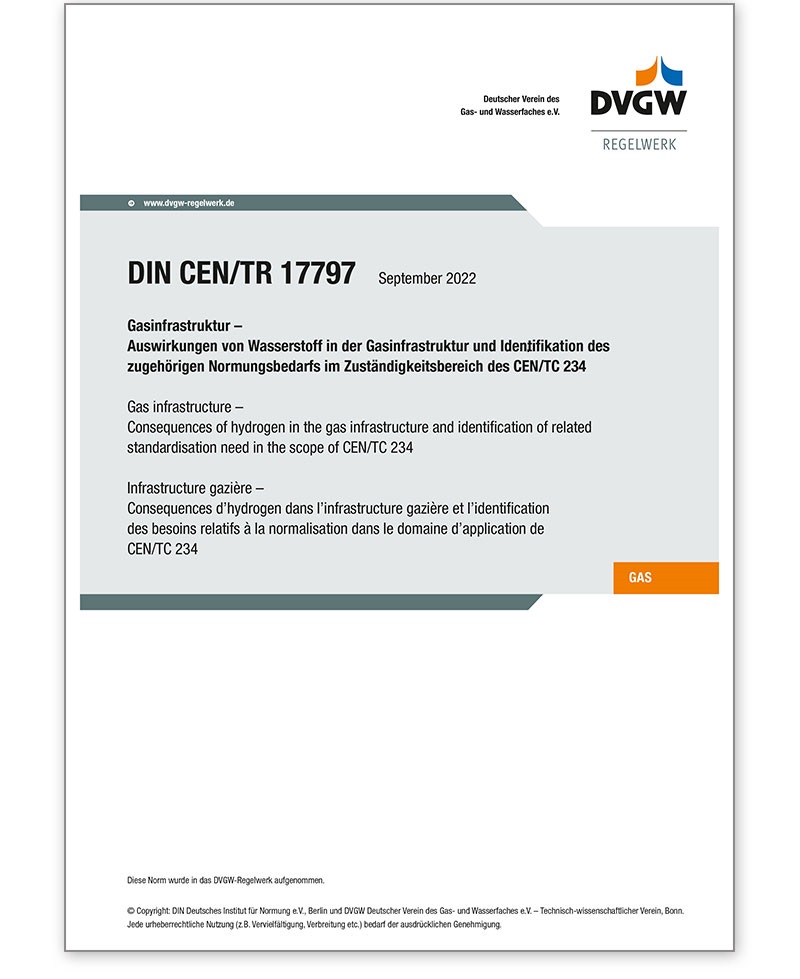
This document DIN CEN TR 17797 is written in preparation of
future standardization and provides guidance on how injection of H2 into the
gas infrastructure can impact processes from the input of gas into the on-shore
transmission network up to the inlet connection of gas appliances.
Funktionale Cookies sind für die Funktionalität des Webshops unbedingt erforderlich. Diese Cookies ordnen Ihrem Browser eine eindeutige zufällige ID zu damit Ihr ungehindertes Einkaufserlebnis über mehrere Seitenaufrufe hinweg gewährleistet werden kann.
Session:
Das Session Cookie speichert Ihre Einkaufsdaten über mehrere Seitenaufrufe hinweg und ist somit unerlässlich für Ihr persönliches Einkaufserlebnis.
PayPal-Zahlungen
Google-Pay-Zahlungen
Mollie Payment:
Dieses Cookie wird verwendet, um alle Ereignisse zu gruppieren, die von einer einzelnen Benutzersitzung auf mehreren Checkout-Seiten generiert wurden.
Cache Behandlung:
Das Cookie wird eingesetzt um den Cache für unterschiedliche Szenarien und Seitenbenutzer zu differenzieren.
Wallee-Zahlungen
Aktivierte Cookies:
Speichert welche Cookies bereits vom Benutzer zum ersten Mal akzeptiert wurden.
Zeitzone:
Das Cookie wird verwendet um dem System die aktuelle Zeitzone des Benutzers zur Verfügung zu stellen.
Google Tag Manager Debug Modus:
Ermöglicht es den Google Tag Manager im Debug Modus auszuführen.
Cookie Einstellungen:
Das Cookie wird verwendet um die Cookie Einstellungen des Seitenbenutzers über mehrere Browsersitzungen zu speichern.
CAPTCHA-Integration
CSRF-Token:
Das CSRF-Token Cookie trägt zu Ihrer Sicherheit bei. Es verstärkt die Absicherung bei Formularen gegen unerwünschte Hackangriffe.
Herkunftsinformationen:
Das Cookie speichert die Herkunftsseite und die zuerst besuchte Seite des Benutzers für eine weitere Verwendung.
Marketing Cookies dienen dazu Werbeanzeigen auf der Webseite zielgerichtet und individuell über mehrere Seitenaufrufe und Browsersitzungen zu schalten.
Bing Ads:
Wird verwendet, um Besucher auf der Website zu identifizieren und deren Verhalten zu verfolgen, um die Effektivität der Werbung zu messen und zu verbessern.
Google Conversion Tracking:
Das Google Conversion Tracking Cookie wird genutzt um Conversions auf der Webseite effektiv zu erfassen. Diese Informationen werden vom Seitenbetreiber genutzt um Google AdWords Kampagnen gezielt einzusetzen.
Google AdSense:
Das Cookie wird von Google AdSense für Förderung der Werbungseffizienz auf der Webseite verwendet.
Tracking Cookies helfen dem Shopbetreiber Informationen über das Verhalten von Nutzern auf ihrer Webseite zu sammeln und auszuwerten.
Bing Ads:
Das Bing Ads Tracking Cookie wird verwendet um Informationen über die Aktivität von Besuchern auf der Website zu erstellen und für Werbeanzeigen zu nutzen.
Google Analytics:
Google Analytics wird zur Datenverkehrsanalyse der Webseite eingesetzt. Dabei können Statistiken über Webseitenaktivitäten erstellt und ausgelesen werden.
Matomo:
Das Cookie wird genutzt um Webseitenaktivitäten zu verfolgen. Die gesammelten Informationen werden zur Seitenanalyse und zur Erstellung von Statistiken verwendet.
Erlaubt es Google, personenbezogene Daten für Online-Werbung und Marketing zu sammeln.
Google Werbung und Marketing
Für Statistiken und Shop-Performance-Metriken genutzte Cookies.
Google Tagmanager
Diese Website verwendet Cookies, um Ihnen die bestmögliche Funktionalität bieten zu können... Mehr Informationen.